Pages

Showing posts with label Content - Chem Theories. Show all posts

Sunday, March 18, 2012

Learning of Organic Chemistry Reactions

The learning of organic chemistry can be difficult if one chooses not to see the relationships between the organic compound and the chemical reactions that take place. Learning the reactions in silo tend to result in a large amount of factual information to grasp and this process can be tedious.

This mind map aims to share the relationship in the reactions that involve alkanes, alkenes, arenes, alkyl halides, aryl halides, phenols, alcohols and nitriles. If would be good if you could see how amines, amides and acid derivatives can be infused into this map.


Organic Chemistry reaction mindmap (click here for a better view)


-- -- -- -- --

Article written by Kwok YL 2012.
Disclaimer and remarks:
  • If you would like to use this source, kindly drop me a note by leaving behind a comment with your name and institution. I am all for sharing as the materials on this blog is actually meant for the education purpose of my students.
  • This material is entirely written by the author and my sincere thanks will be given to anyone who is kind, generous and gracious to point out any errors.

Sunday, July 17, 2011

Ideal Gas - Assumptions

The ideal gas laws resulted in the following ideal gas equation:


PV = nRT


The basis of the equation is on the following three points. For the same number of moles of gas particles:
  1. The pressure of the gas is directly proportional to temperature, provided volume of gas is constant.
  2. The volume of the gas is directly proportional to the temperature, provided temperature of the gas is constant.
  3. The pressure of the gas is inversely proportional to volume of the gas, provided temperature of the gas remains constant. This makes sense as when I increase pressure, the volume of space that the gas particles can move around in becomes smaller.
These three laws result in the two assumption of ideal gases:
  1. The intermolecular forces of the gas is insignificant.
  2. The size of the gas particles is negligible (or the volume of the gas molecule is negligible)
However, real gas deviates from these assumption because they have intermolecular forces, either Van der Waals' interactions or Hydrogen-bonding. In addition, the size of the gas particles is not negligible - the gas molecule has a volume and it is not a point particle. Therefore, when ideal gas is subjected to increasing pressure, the PV term remain constant. However, when real gas is subjected to increasing pressure, we first observe a dip and then subsequently the PV value soars.

(1) The dip in PV value for real gas.
This can be reasoned. When the pressure starts to increase and it is not sufficiently high, the gas would come close together. This provides the opportunity for the individual gas particles to interact with each other as they are able to cause their intermolecular forces to act upon each other. Once the intermolecular forces act that serves as an additional pull that brings the gas particles closer together and hence the volume of the gas is smaller than predicted hence the PV term is smaller, thus resulting in the dip.

The sheer fact that real gases have intermolecular forces, this is the reason why gases can be condensed to liquid state. The absence of intermolecular force will mean that it is impossible for gases to liquidfy.

(2) The PV value soars.
At a given high pressure imposed on an ideal gas, the PV term remains the same as when the gas experiences a lower pressure. As gases can be compressed, the volume of the gas (which can be seen as the volume of the space the gas particle is traveling in) cannot be directly obtained. It is actually approximated from the volume of the container that contains the gas. Although, the volume of the container consists of the volume of the space the gas can move in and the volume of the molecules, this "guess" is perfectly fine for ideal gas as the particles are point particles (hence the particles have no volume). Thus, the volume of the container is a good approximate to the volume of space that gas particles can travel in.

However, for real gases when it is subjected to high pressure (and if it still remains as a gas), the size of the particles become significant as compared to volume of the space the particles move in. Hence, for a fixed container, the significant size of the particles reduces the volume of the space that the particles can travel in and hence the volume of the gas is actually smaller than the actual volume of the container. Since the volume of the container is used in the calculation, this results in the PV to be larger than expected.

The molecular interpretation of this increase can be seen when we have the gas particles so close together that their respective electron cloud comes into contact with each other.  This results in a repulsion and "pushes" the particles away from each other, increasing their volume.

As we deal with the environment which makes up of a mixture of different gases, it useful to remind ourselves the purpose of Dalton's Law of partial pressure. The law states that when we have a mixture of gases which do not interact chemically with each other, the total pressure of the gas mixture is the sum of the individual partial pressure of the different gases that make up the mixture.

-- -- -- -- --

Article written by Kwok YL 2011.
Disclaimer and remarks:
  • If you would like to use this source, kindly drop me a note by leaving behind a comment with your name and institution. I am all for sharing as the materials on this blog is actually meant for the education purpose of my students.
  • This material is entirely written by the author and my sincere thanks will be given to anyone who is kind, generous and gracious to point out any errors.

Sunday, April 17, 2011

Expansion of Octet. Why do elements do it?

Most of the elements do not have the noble gases' electronic configuration. Since the latter is generally unreactive, we have come to the conclusion that the octet configuration is stable and that the other elements would aim to achieve it. These elements can only achieve the octet configuration via chemical bonding; either forming of a covalent bond or an ionic bond with another atom.

However, we also noticed that there are compounds which clearly show that the element can form more bonds such that they have more than the 8 electrons around it. Compounds such as PCl5 and H2SO4; where phosphorous and sulfur have 10 and 12 electrons around them respectively. Glaringly, all the elements which are found in the first and second period of the periodic table does not form compounds in which they have more than 8 electrons around them.

Therefore, these observations together with the knowledge of quantum shells, subshells and orbitals, we are able to come to the conclusion that elements found from Period 3 and beyond, have available empty orbital which must be energetically accessible to accept electrons for bonding. Thus, these elements are able to accept more electrons to bond with other elements. This results in the expansion of octet. In the case of PCl5, phosphorous must have caused one of its valence electron to be excited to the 3d subshell (its energetically accessible orbital), so that it has 5 orbitals available for bonding and hence able to form a single bond each with 5 chlorine atoms.

However, is it that random, is it simply that elements which have energetically accessible orbital will exercise that privilege to use them? How do we account for compounds such as XeF2?  Xe a clear noble gas element and yet it is willing to expand its octet, why would it do so? The expansion of the octet results in the elements to be able to make use of their energetically accessible empty orbitals. These orbitals are energetically slightly higher than the orbitals which the valence electrons are found. Hence, if the element wants to expand its octet, it will excite some of its valence electrons to the empty and energetically accessible orbital, so that they can form a bond with another atom via equal sharing of electrons or accept a pair of electrons from the donor to form a dative bond. If this is a favourable process, the energy from the formation of the bond must have compensated the energy needed to move a valence electron out of it the orbital that it resides in.

This is the complete reason to why the Period 1 and Period 2 elements do not expand their octet.  Their next empty orbital belongs to a different principal quantum shell. Hence, to make use of it for bonding would require a large amount of energy, and it is not compensated by the energy formed from the bond formation. Therefore, the combination of these two reasons allow us to observe expansion of octet in some elements and not all of them.

Interestingly, the cation of an ionic compound generally do not favour expansion of octet which results in formation of another neutral compound.  (For example adding more F2 to MgF2 to form MgF4.) This is because it results in Mg to use more than 2 valence electrons for bonding.  This is energetically meaningless for the atom as it will have to invest in large amount of energy to make use of an inner shell electrons for bonding.  Hence, if cation wants to expand its octet, then it needs to have energetically accessible empty orbital to accept electron pairs from a donor.

-- -- -- -- --

Article written by Kwok YL 2011.

Disclaimer and remarks:
  • If you would like to use this source, kindly drop me a note by leaving behind a comment with your name and institution. I am all for sharing as the materials on this blog is actually meant for the education purpose of my students.
  • This material is entirely written by the author and my sincere thanks will be given to anyone who is kind, generous and gracious to point out any errors.

Sunday, April 10, 2011

Theory: Bond energy of A - B is the average of Bond energies of A-A and B-B

Let's try to make sense to one of the many theories in chemical bonding. We understand that the bond energy represents the amount of energy that is needed to break one mole of a covalent bond. Hence, the larger the bond energy, the stronger the bond. Interestingly, one of the theories in chemical bonding suggests that the bond energy of A-B is the average of the sum bond energy of A-A and the bond energy of B-B.

In this write-up, I will propose my interpretation to how this theory is obtained and hence using this as an angle to account for the anomalous situations. The Molecular Orbital (MO) theory best explains how the covalent bond is formed and this theory succinctly focuses on the overlapping of atomic orbital (Click here for some explanation to MO theory). While, at the GCE "A" level, we learn about overlapping of orbital for the formation of covalent bond; this is basically the fundamental and not the complete picture of MO theory. Nonetheless, this simple idea used in the "A" level is still competent to account for the theory of this topic.

Two assumptions are made when we talk about overlapping of atomic orbital to form covalent bond using the "A" level idea.  These will help to explain the theory in discussion:  
  1. We assume that only a certain proportion of the atomic orbital will be used for bonding. Hence, when small atoms overlap with each other, the proportion of the overlap over the total area of the orbital is larger than for big atoms - that is where we obtain the term "effective overlap of atomic orbitals" to determine our strength of our covalent bonds. Strength of covalent bond is then told to us via bond energy. 
  2. We assume that the atoms will always only make use of that same particular portion of their atomic orbital for bonding, regardless of the identity of the other atom.
These two propositions will suggest that if we half the bond energy of A-A, we can infer the area of the atomic orbital that the atom is using for bonding. This would be a fair suggestion, as a bond is made up of overlapping between two atomic orbital and the effectiveness the overlap (and hence the proportion used for overlapping) is told to us by the bond energy.

This explanation will nicely allow us to agree that the average of the sum of the bond energy of A-A and B-B will give us the bond energy of A-B.

However, when A and B is of different electronegativity, the electron cloud (which contains the bonded electrons) between A and B is pulled towards the atom which is more electronegative. You maybe incline to conclude that the area of the atomic orbital used for overlapping between A and B, may not be the same as A bonds with A and when B bonds with B (we can only ascertain this through theoretical calculations).  More importantly, the difference in electronegativity results in an added electrostatic attraction between partial charges that are formed in A and B; not accounted by the merely overlapping of atomic orbital.  The added electrostatic attraction creates our polar covalent bond.  A covalent bond with partial charges at each end.

Deviation to this theory is due to the weakness of the theory.  Essentially, it only accounts for a covalent bond formed between two atoms due to only the overlapping of atomic orbital. While, in the case of polar covalent bonds, we now know that there are two factors that result in this covalent bond to be formed:
  1. Overlapping of atomic orbital and the constituent atoms; and 
  2. Electrostatic attraction of partial charges due to the electronegativity difference of the constituent atoms.
-- -- -- -- --

Article written by Kwok YL 2011.
Disclaimer and remarks:
  • If you would like to use this source, kindly drop me a note by leaving behind a comment with your name and institution. I am all for sharing as the materials on this blog is actually meant for the education purpose of my students.
  • This material is entirely written by the author and my sincere thanks will be given to anyone who is kind, generous and gracious to point out any errors.
Saturday, February 13, 2010

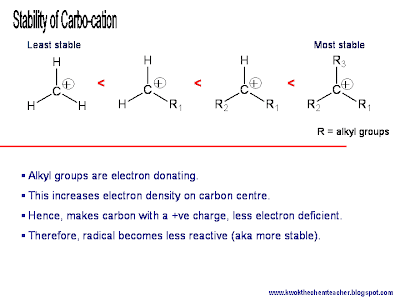
Effect of Alkyl Groups.

In organic chemistry, we consider alkyl groups to be electron donating. They are able to donate electrons via a means called hyperconjugation. When alkyl groups are linked to a carbon with a positive charge or a carbon with an unpaired electron, the alkyl groups with its electron donating properties stabilises the carbocation (or radical).

On the other hand, alkyl groups when attached to the benzene ring, donate electron density towards the ring and hence making the benzene ring more reactive toward electrophiles.

Hence, is the electron donating property of alkyl groups stabilising or destabilising?

Well, the answer is lies in the effect that the electron donating property causes. In the case of carbocations (and radicals), the alkyl groups donates their electron density towards the electron deficient carbon.

Hence, by donating the electron density, the alkyl group is no longer neutral in charge but rather carry some partial positive charge; inevitably sharing the positive charge (or the extent of electron deficiency) with the carbon that has the positive charge.

However, in the case of the methylbenzene, the alkyl groups donate electron density to the electron ring. This makes the pi electron ring richer in electron density and hence more susceptible to electrophilic attacks.

It is timely to remind ourselves that in the electrophilic substitution mechanism, the slow step is the reaction between the benzene ring and the electrophilc.

Hence, seeing the effect caused by the alkyl groups will lead us to making the correct choice to whether they stabilises or destabilises.

-- -- -- -- --
Article written by Kwok YL 2010.

Disclaimer and remarks:
  • If you would like to use this source, kindly drop me a note by leaving behind a comment with your name and institution. I am all for sharing as the materials on this blog is actually meant for the education purpose of my students.
  • This material is entirely written by the author and my sincere thanks will be given to anyone who is kind, generous and gracious to point out any errors.